Wind Symphony welcomes guests, The Boston Brass 11/22/24
Friday, Nov. 22, 2024 • 7:30 p.m.
Weigel Auditorium
Columbus, OH
Russel C. Mikkelson, conductor
Uiliami Fihaki, guest conductor
Boston Brass, guest artists
The appearance of the Boston Brass is made possible by a generous gift from Ms. Sarah Brown.
Program
Postcard
Frank Ticheli (b. 1958)
Uiliami Fihaki, conductor
Postcard was commissioned by my friend, colleague and former mentor, H. Robert Reynolds, in memory of his mother, Ethel Virginia Curry. He requested that I compose not an elegy commemorating her death, but a short energetic piece celebrating her life. In response, I have composed this brief "postcard" as a musical reflection of her character — vibrant, whimsical, succinct.
It is cast in an ABA' form. The primary theme, first heard in the flute and clarinet and used in the outer sections, is a palindrome — that is, it sounds the same played forwards or backwards. This theme honors a long-standing tradition in the Reynolds family of giving palindromic names (such as Hannah and Anna) to their children. H. Robert Reynolds' first name is Harrah. The theme's symmetry is often broken, sometimes being elongated, other times being abruptly cut off by unexpected events.
The B section is based on a five-note series derived from the name Ethel: E (E natural), T (te in the solfeggio system, B flat), H (in the German system, B natural), E (E-flat this time), L (la in the solfeggio system, A natural). The development of this motive can be likened to a journey through a series of constantly changing landscapes.
The ‘A' section is articulated by the return of the main melody. This section is not identical to the A section, but is close enough in spirit to it to give the effect of a large-scale palindrome surrounding the smaller ones.
— Note by the composer
Two Works by Percy Grainger
Percy Grainger (1882–1961)
1. Irish Tune from County Derry
2. Shepherd’s Hey
Irish Tune from County Derry (published 1918) is based on earlier settings that date back as early as October 1902 with an essentially identical setting of this melody for wordless mixed chorus. Later versions for solo piano (1911) and string orchestra with two optional horns (1912) followed. The wind band setting is cataloged as British Folk Music Setting Nr. 20, and like all his settings of British folk music is “lovingly dedicated to the memory of Edvard Grieg.” The composer’s brief program note states, “This tune was collected by Miss J. Ross, of New Town, Limavady, Co Derry, Ireland and published in The Petrie Collection of the Ancient Music of Ireland, Dublin, 1855.
In some agricultural districts in England, teams of “Morris Men”, decked out with jingling bells and clicking sticks, can still be seen dancing to such traditional tunes as Shepherd's Hey, which are usually played on a fiddle or a combination of fife and drum. This is one of the many wonderful renditions of English folksongs transcribed by Grainger. Originally penned for an ensemble of 12 instruments in 1911, the band version was transcribed by the composer in 1948.
— Note from Windband.org
Perplexing Times
Gordon Goodwin (b. 1954)
Boston Brass, guest artists
Perplexing Times for Boston Brass, Wind Band, and Rhythm Section is a composition that reflects fun, positivity, and wit, but with a light dusting of sass. You can hear a number of different emotions in it — some confusion and quirkiness (actually a fair amount of confusion and quirkiness), some fear and defiance, but also some hope and beauty.
It has been a joy and honor to collaborate on this project with the esteemed Boston Brass. The versatility of this fine ensemble is one of its great strengths and provides a wide canvas for any composer. I have endeavored to produce a piece that reflects the wide stylistic range and broad musical values that appeal both to me as a composer and the members of the group as performers. Adding the wind ensemble instrumentation and rhythm section has provided a great variety of colors and shades to choose from in fashioning this composition for the legendary Boston Brass.
— Note by the composer
— Intermission —
Pluto, the Last Planet
Bruce Edward Miller (b. 1957)
Boston Brass, guest artists
Pluto, The Last Planet was commissioned by the Boston Brass and Dr. Robin Dinda, organist; the work is dedicated to them. The title gets its name from the suggestion of a friend's grandson. He was aware of the work The Planets by Gustav Holst and knew that it did not include Pluto (the composition was finished in 1916 and the planet was not discovered until 1930). He suggested I write the final planet — hence the title. The players wanted something heroic, uplifting, lively, and perhaps programmatic — hence the general tone of the work.
The work was premiered in its original form (brass quintet and organ) on October 23, 1993, at the First Church of Nashua in New Hampshire by the above-named people.
— Note by the composer
Symphony No. 6, The Blue Marble
Julie Giroux (b. 1961)
1. The Big Blue Marble
2. Voices in Green
3. Let There Be Life
Movement I. The Big Blue Marble. It is often said that the first full imagine of Earth, “Blue Marble,” taken by Apollo 17 in 1972, was the first full picture of the planet Earth. The picture is actually upside down. It happened sometime between 4:59:05 and 5:08:14 hours after Apollo's launch as they traveled up to 25,000 miles an hour. It is the most reproduced picture in history. It became painstakingly clear to humanity just how small and vulnerable our one and only home actually is. This movement celebrates that home in a variety of ways; think of it as an abbreviated introduction to planet Earth through music.
Movement II. Voices in Green. I spent hours simply listening to the recordings of the Amazon jungle by the world-renowned sound engineer George Vlad. The recordings were made during the rainy season when humidity is at its highest and birds are the most vocal. The sounds transport you into the heart of the jungle which feels incredibly, alive. The exotic calls of the birds and the echoes from other birds of the same species, the insects, the frogs and the rain; you can practically feel and smell the rain. The rain forest has its own music. The density of growth with every shade of green, is the backdrop for this beautiful, strange opera.
I knew I wanted to write music to those sounds. I composed Voices in Green with the Amazon jungle sounds playing as my audio backdrop. It influenced every note and phrase. In my mind and heart, I was there, adding my voice to theirs. Voices in Green can be performed strictly on its own…Think of this movement as a concert taking place in the heart of the Amazon rain forest.
Movement III. Let There Be Life. Violence, death, murder, birth, and life: I wanted to capture that commonality with music in the third and final movement. There is a recurring theme throughout the finale. It evolves, much like life on Earth. It moves through the music, transporting us from one musical setting to the next, ending in a majestic, grandiose way.
The miracle of Earth is life. It is the fragile, silken thread that holds existence together. As with the famous Blue Marble photograph, I hope this symphony reminds people just how frail and beautiful Earth is.
I hope The Blue Marble fills hearts and minds with a renewed loved for our planet, our one and only home. Earth is the one thing we all have in common. It does not belong to us. We belong to it. It is our only home and we should always treat it as such with every generation leaving it healthier and happier than the way they found it.
— Note by the composer
Guest Artists | Personnel
Boston Brass
Boston Brass
José Sibaja, trumpet
Jeff Conner, trumpet
Chris Castellanos, horn
Domingo Pagliuca, trombone
William Russell, tuba
Since 1986 Boston Brass has set out to establish a one-of-a-kind musical experience featuring colorful classical arrangements, burning jazz standards, and the best of original brass repertoire. Boston Brass treats audiences to a unique brand of musical entertainment that bridges the ocean of classical formality to delight regular concertgoers and newcomers alike with great music and boisterous fun in performances across all 50 U.S. states and over 30 countries to date.
José Sibaja brings an incredible level of artistry, humor and personality to Boston Brass. José has held positions in the Miami Symphony, the Sinfonieta de Caracas and the Orquesta Sinfonica Venezuela, and has performed as soloist with the Springfield Symphony, Orquesta Sinfonica Venezuela, and Orquesta Sinfonica Nacional de Costa Rica. He toured the world in Ricky Martin’s band for 8 years and can be heard in countless recordings with artists such as Celia Cruz, Gloria Estefan, and Alejandro Sanz, and has performed on Late Night with David Letterman, The Tonight Show with Jay Leno, Saturday Night Live, and the Grammys. José is currently Professor of Trumpet at the Blair School of Music, Vanderbilt University in Nashville.
Jeff Conner is the only remaining original member of Boston Brass. He founded the group with fellow Boston musicians while studying at Boston University and has engineered the meteoric rise of the ensemble in the world of popular chamber music. Jeff received his master’s degree in music from Boston University and his bachelor’s degree in music from Boston Conservatory. He has presented his Entrepreneurial Clinic “The Portfolio Musician” around the world, and is the author of The Portfolio Musician: Case Studies in Success, with co-author Grammy-nominated musician John Laverty.
Chris Castellanos hails from Las Vegas where he studied at UNLV and was formerly a member of the Las Vegas Philharmonic. Chris has shared the stage with the Utah Symphony, Miami Ballet, Rodney Marsalis Philadelphia Big Brass, Nevada Chamber Orchestra, Las Vegas Jazz Connection, and the TAD Wind Symphony of Japan. In Vegas, Chris has played over 1,700 performances of Andrew Lloyd Webber’s Phantom — The Las Vegas Spectacular and backed artists like Frank Sinatra Jr., Tony Bennett, Johnny Mathis, Peter Cetera, Peabo Bryson, Kenny G, Robert Goulet, Olivia Newton-John, Placido Domingo, Luciano Pavarotti, Michel Legrand, Mannheim Steamroller, Yes, Josh Groban, Michael Bublé, Charlotte Church, Ricky Martin, David Foster, and Andrea Bocelli.
Domingo Pagliuca is a Latin Grammy Award-winning trombonist who was born in Venezuela and graduated with honors from the University of Miami with Bachelor’s and Master’s degrees in music. His versatility as an instrumentalist in different musical genres has led him to be one of the most in-demand musicians in Venezuela and Latin America for recording sessions and musical productions in the commercial field. Currently, Domingo serves as principal trombone of both the Palm Beach Symphony Orchestra and the Florida Grand Opera Orchestra.
William Russell is the newest member of Boston Brass, joining in 2017. William was a co-founder of the Chicago-based quintet Alliance Brass, and is an alumnus of the Civic Orchestra of Chicago. William has performed across the United States in venues from the Corn Palace to Carnegie Hall, and he has toured Europe with both the Chicago Symphony Orchestra and the Accademia Nazionale di Santa Cecilia; he can be heard on the Chicago Symphony Orchestra’s Grammy-winning 2008 recording of the Shostakovich 4th Symphony. At home in Chicago, William teaches tuba and euphonium at Northeastern Illinois University.
Boston Brass is a Yamaha Performing Group and performs exclusively on Yamaha instruments. Boston Brass plays mouthpieces by Pickett Brass.
Wind Symphony musicians
WIND SYMPHONY
Russel C. Mikkelson, conductor
Piccolo
Braden Stewart
Katie Sharp
Sofia Geelhood
Flute
Katie Sharp *
Jonathan Mitchell
Braden Stewart
Sofia Geelhood
Lance Korte
Shreeya Yampati
Allie Gerckens
Oboe
Lauren Kowal *
Sophie Craciun
Laura Pitner
English Horn
Laura Pitner
Bassoon
Brandon Golpe *
Isaiah Heyman
Bitania Petros
Contrabassoon
Isaiah Heyman
Eb Clarinet
Bernadette John
Clarinet
Kaleigh McGee *
Xinchen Du
Bernadette John
Samuel Langer
Joseph Zishka
Asa Mattson
Joseph DeCillis
Christopher Larsen
Favius Pena-Amaya
Bass Clarinet
Rachel Weinstein *
Mason Williams
Alto Saxophone
Lucinda Dunne *
Cooper Greenlees
Tenor Saxophone
Sean Bauman
Baritone Saxophone
Colin Fogerty
Horn
Annie Moon *
Cheng Peng
Olivia Boden
Andrew Waite
Paul Bissler
Nora Lemmon
Trumpet
Luke Bingham *
Nick Schnitzspahn
Zach Heffner
Bobby Petty
Connor McMullen
Will Fisher
Abbey Zunic
Trombone
Tristan Miller *
Charlotte Stefani
Gavin Abrams
Alex Myers
Nik Henderson
Bass Trombone
Shawn Davern
Euphonium
Davis Aho *
Ayden Casa
Andrew Eynon
Tuba
Justin White *
Patrick Woo
Will Roesch
Percussion
Haydn Veith *
Matt Hanson
Brody Fogle
Noah Landrum
Stephen Alexander
Kye Pyeatt
Sam Sherer +
Nathan Smith +
Adam Quinn +
Garrett Campbell +
Piano/Celeste
CJ Smyth-Small
Double Bass
Dallas Carpenter (faculty)
Harp
Abigail Bachelor (faculty)
* principal
+ assisting musician
Join us…
School of Music performances are free, unless indicated otherwise. Many performances are livestreamed for later viewing.
Receive reminders about upcoming events in the School of Music. Subscribe to OVATION, our weekly e-newsletter.
Visit Events for upcoming performances, lectures and more.
Visit Outreach for opportunities for middle/high school musicians and educators.
Interested in lessons? Our Community Music School offers opportunities for all ages and ability levels.
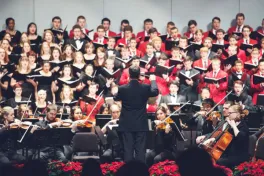
30th Annual Music Celebration Concert
Join us for our annual community celebration featuring student bands, choirs, jazz bands, orchestra and more.
Wednesday, Dec. 4 at 7:30 p.m. in Mershon Auditorium